PNA5 - MasR Agonist
PNA5 - MasR Agonist
PNA5 - MasR Agonist
ProNeurogen Peptides are Selective Mas Receptor Agonists
ProNeurogen Peptides are Selective Mas Receptor Agonists
PNA5 Mechanism of Action
PNA5 Mechanism of Action
• PNA5 is a glycosylated-Angiotensin-(1-7) peptide related to the Renin-Angiotensin family
• PNA5 binds to small GPCR Mas receptor
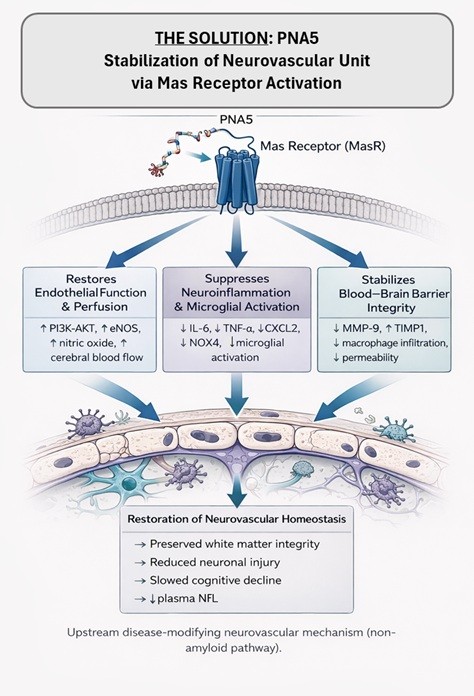
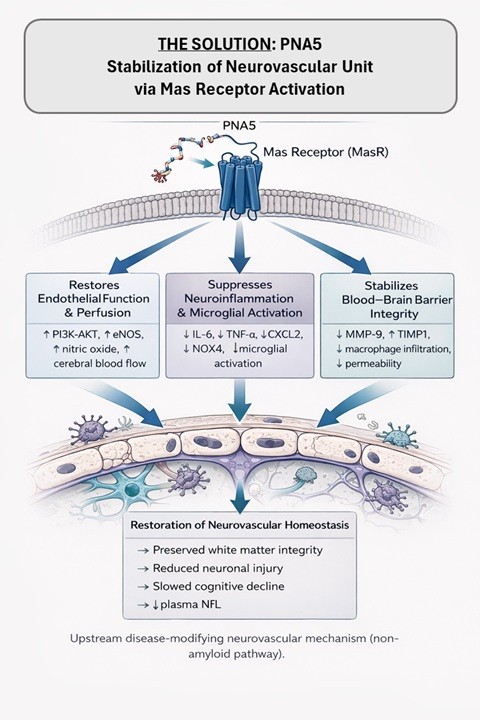
• PNA5 activation of Mas results in inhibition of inflammation, ROS and increased brain blood flow via activation of e-NOS.
• Through these mechanisms, PNA5 actions result in neuroprotection and improved memory function.
PNA5 Mechanism of Action
• PNA5 is a glycosylated-Angiotensin-(1-7) peptide related to the Renin-Angiotensin family
• PNA5 binds to small GPCR Mas receptor
• PNA5 activation of Mas results in inhibition of inflammation, ROS and increased brain blood flow via activation of e-NOS.
• Through these mechanisms, PNA5 actions result in neuroprotection and improved memory function.
PNA5 Mechanism of Action
• PNA5 is a glycosylated-Angiotensin-(1-7) peptide related to the Renin-Angiotensin family
• PNA5 binds to small GPCR Mas receptor
• PNA5 activation of Mas results in inhibition of inflammation, ROS and increased brain blood flow via activation of e-NOS.
• Through these mechanisms, PNA5 actions result in neuroprotection and improved memory function.
Novel approach – new peptide drug class
Glycosylated-Ang-(1-7) Peptides
Target: MasR receptor
Mechanism: Anti-inflammatory
Excellent Brain Penetration
Efficacious for chronic bone pain, neuropathic pain
Extremely safe
ProNeurogen’s Pain Drug Candidates
ProNeurogen’s Pain Drug Candidates
ProNeurogen’s Pain Drug Candidates
Portfolio Expansion
Portfolio Expansion
PNA5 Mechanism of Action
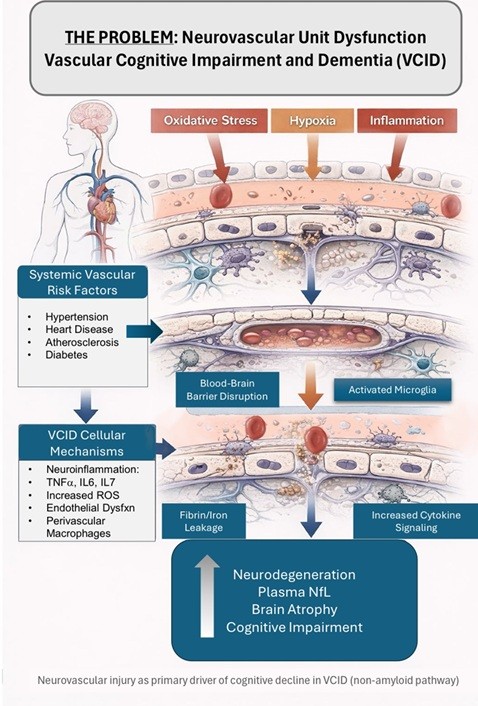
Validated Mas receptor biology enables expansion into additional neurovascular, neurodegenerative, and neuroinflammatory disorders.
NEUROVASCULAR: Active human studies in traumatic brain injury and post-operative cognitive impairment with PNA1 demonstrate ready translation of PNA5 to human studies.
NEURODEGENERATIVE: Preclinical program in Parkinson's cognitive impairment and exploratory work in cerebral amyloid angiopathy extend the platform's reach into chronic disease.
NEUROINFLAMMATORY: NIH-funded development in neuropathic and inflammatory pain confirms mechanism continuity in peripheral and central inflammation.
Each expansion uses the shared biomarker suite and regulatory system, requiring no new infrastructure.
Validated Mas receptor biology enables expansion into additional neurovascular, neurodegenerative, and neuroinflammatory disorders.
NEUROVASCULAR: Active human studies in traumatic brain injury and post-operative cognitive impairment with PNA1 demonstrate ready translation of PNA5 to human studies.
NEURODEGENERATIVE: Preclinical program in Parkinson's cognitive impairment and exploratory work in cerebral amyloid angiopathy extend the platform's reach into chronic disease.
NEUROINFLAMMATORY: NIH-funded development in neuropathic and inflammatory pain confirms mechanism continuity in peripheral and central inflammation.
Each expansion uses the shared biomarker suite and regulatory system, requiring no new infrastructure.
Validated Mas receptor biology enables expansion into additional neurovascular, neurodegenerative, and neuroinflammatory disorders.
NEUROVASCULAR: Active human studies in traumatic brain injury and post-operative cognitive impairment with PNA1 demonstrate ready translation of PNA5 to human studies.
NEURODEGENERATIVE: Preclinical program in Parkinson's cognitive impairment and exploratory work in cerebral amyloid angiopathy extend the platform's reach into chronic disease.
NEUROINFLAMMATORY: NIH-funded development in neuropathic and inflammatory pain confirms mechanism continuity in peripheral and central inflammation.
Each expansion uses the shared biomarker suite and regulatory system, requiring no new infrastructure.
Intellectual Property
Intellectual Property
PNA5 Mechanism of Action
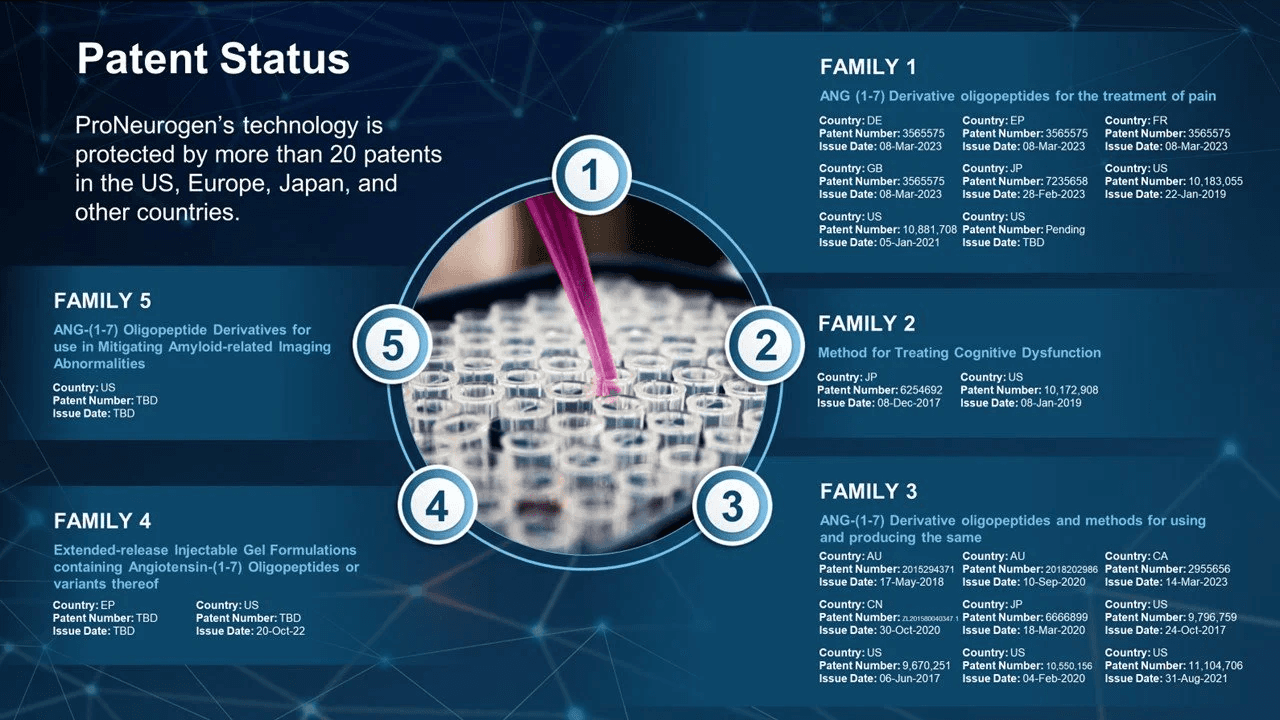
Five patent families with 25 issued and four pending patents cover composition, formulation, and therapeutic use of Mas receptor analogs under an exclusive University of Arizona license.
Five patent families with 25 issued and four pending patents cover composition, formulation, and therapeutic use of Mas receptor analogs under an exclusive University of Arizona license.
Five patent families with 25 issued and four pending patents cover composition, formulation, and therapeutic use of Mas receptor analogs under an exclusive University of Arizona license.
Patent Portfoliio
Patent Portfolio
Patent Portfolio